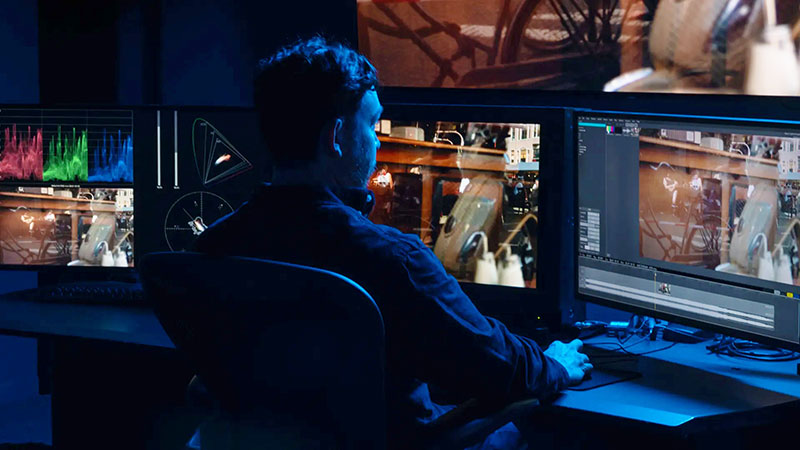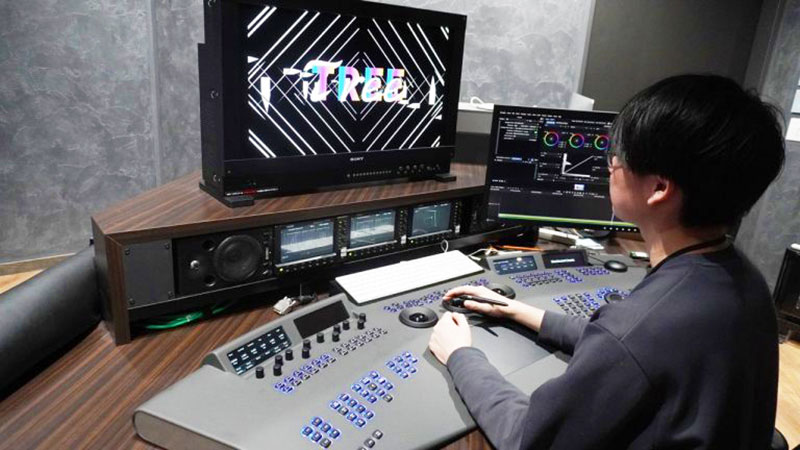


Independent colourist Cem Ozkilicci took part in FilmLight’s Baselight v7 beta, putting new features like Transform Matching, Depth Keyer and Segment Anything through real‑world tasks.

Cem Ozkilicci, an independent colourist based in Oslo, Norway, took part in FilmLight’s Baselight v7 beta, spending several months putting the new features through real‑world tasks. He has used the software on commercial work, long form feature content and fast turn-around corporate content, and his feedback helped to shape the look and functionality of the new release.
For Cem, being part of the Baselight v7 beta wasn’t only about getting early access. “If I’m going to depend on these tools every day, it makes sense to be involved in how they evolve,” he said. “You spot things in real jobs that no controlled test will ever reveal, and I love being part of the process.”
Going Remote
Ozkilicci works mainly out of his studio in Oslo, Norway, where the core of his colour pipeline centres on a Baselight ONE Linux system with a Blackboard Classic control panel. However, by utilising FilmLight REMOTE, his workflow extends beyond the physical suite – he also has access to the full system from an at-home office with a Slate control panel, where he can experience the same functionality, performance and responsiveness.
REMOTE integrates a FilmLight control surface, UI monitors, mouse and keyboard with professional monitoring over the internet. “REMOTE is so close to the real thing that I’ll sometimes forget I’m not in the suite,” he said. “For freelance life, it makes late tweaks, international clients, tight turnarounds and so on much more manageable.”
Transform Matching
Cem has been grading on Baselight for 12 years and become very familiar with its set of features. For him, one of the standout additions in Baselight v7 is Transform Matching.

Matching offline and conformed images is often time-consuming, particularly when transform data is missing or inaccurate. Transform Matching removes the guesswork by analysing a reference image and automatically matching the scaling, rotation and translation. Colourists can apply these values to single frames or entire shots, with keyframes created as they are needed.
“It sounds like a small thing,” Cem noted. “But when you’re dealing with a massive number of shots with dynamic reframing, being able to match transforms automatically saves a huge amount of time.” He found it especially effective on commercial timelines, where shots frequently shift in scale or position, or both.
“Normally you’d have to realign every shot manually, but with Transform Matching you can reframe everything the way the client intended in editorial without the pain of re-doing it manually. He recently used this tool on an eight-minute corporate video in which around 80% of the footage involved dynamic reframing. Manually, that would have taken at least two days. With Transform Matching, it took about 20 minutes. The Flame artists I speak to are jealous.”
For colourists, particularly freelancers, this time saving is significant. Conform work is essential but often underestimated and even unpaid. “Whether you’re working on a 90-second spot, a 10-minute short, a documentary or a feature, conform always takes time,” Cem said. “Also, because the producer is not often privy to this work, we don’t always get paid for it in full. “Even in larger facilities, reducing conform time is a major advantage. If one studio estimates a week for conform and another can do it in two days, that’s a big plus.”
Segment Anything
Segment Anything is a plug-in Flexi Effect that generates mattes using image segmentation. Using the tool, colourists can select the objects they need to isolate using a rectangle or by adding points to the image. They can also use layers to organise multiple objects and control the visibility of objects throughout a shot.
“It’s especially valuable when you are working with products in commercial work,” said Cem. “I put it straight to use on a Coca‑Cola commercial I was working on in the summer, where precise bottle and label isolation was essential. I didn’t have time for rotoscoping, and it handled the bottle and label extremely well.”
“For product work it makes a huge difference to timeframes. You can get clean masks in seconds. Plus, it also brings a wow factor for clients, too – they love to see that you can isolate pretty much anything on screen.”

He noted that tiny details occasionally needed refinement, but the time saved was substantial. “It frees you up to think creatively instead of technically. I could focus on shaping highlights and pushing the colour instead of spending an hour building a matte,” he commented.
Depth Keyer
The new Depth Map generator in Baselight v7 creates beautiful, high quality depth maps from live action shots. The output from it is automatically assigned to a Depth channel, which makes it available to any effect in the stack. Colourists can use the Depth Keyer to generate a matte based on the output of the Depth Map, allowing corrections guided by the depth information from the image.
“Depth Keyer was one of the main reasons I jumped on v7,” Cem said. “I was using another tool at the time that did the job but it struggled in certain scenarios, so I was excited to get the enhanced keyer tools in Baselight.
“You can use it to make really subtle adjustments, bringing a person or object forward or pulling the background back just enough to feel more depth. I used this on the Coca-Cola ad as well, where I needed to darken the background and bring up the foreground. And, in some instances, I needed to do the opposite, since the light in the background was going down and we needed as bright a feeling as possible.”
For Cem, Baselight v7 has brought a set of tools that are more than just cool demos. He said, “They are tools I’ve already used on real jobs. The tools reduce repetitive work, save me large amounts of time and support me both technically and creatively.” www.filmlight.ltd.uk