

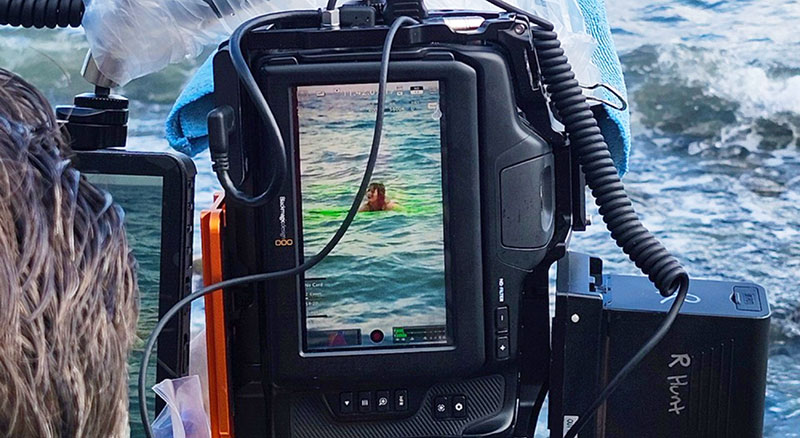
Blackmagic Pocket Camera 6K Pro and PYXIS 6K were chosen to shoot a 9:16 micro drama pirate adventure, taking advantage of the compact size, Blackmagic RAW and colour science.
Showrunner and writer Julie Bruns first arrived at the idea for her most recent vertical micro drama Beneath Crimson Sails a year ago in June 2025. “Vertical series fans were calling for a pirate themed production,” said Julie. “Having loved pirates since I was a kid, I was already hooked.”
Julie also stars in the film as Catharine, a young woman compelled to find the missing half of a cursed map and avenge her father’s death. When she meets a pirate captain pursuing his own secrets, they are pulled toward a dangerous, hidden past that could destroy them both.
By the end of August 2025, the production was already shooting. Like many of the crew, Julie worked as showrunner and took on several other roles as well. Julie wrote the script, produced and starred, while Steven Kammerer directed, produced and acted in the role of Silas the Treasure Mage. Rob Hunt, David Titus and Nic Westaway, who also stars as Captain Rob, co-directed a number of episodes each. Rob also handled producing as well as cinematography duties and David was a co-editor.
The project was produced by Thunder Child Productions in partnership with Executive Producers David Aboussafy of Generativity Productions and Carin Smolinski of WEC Films, both of whom appear in the film.
Visual Goals
Visually, the goal was clear from early on. “We wanted it to be a nostalgic nod to classic films like The Princess Bride with a feeling of a full fantasy world,” said Julie.
She and Steven Kammerer had both acted in dozens of vertical micro dramas before taking on the production, and that experience sharpened their expectations of the format. Roughly 70 percent of the film is composed of closeups, with faces filling the frame, and in between the scenes and sequences, it breaks wide to the rugged coastlines of British Columbia, Canada for swordfights, which were carefully staged up and down hillsides and landscapes.
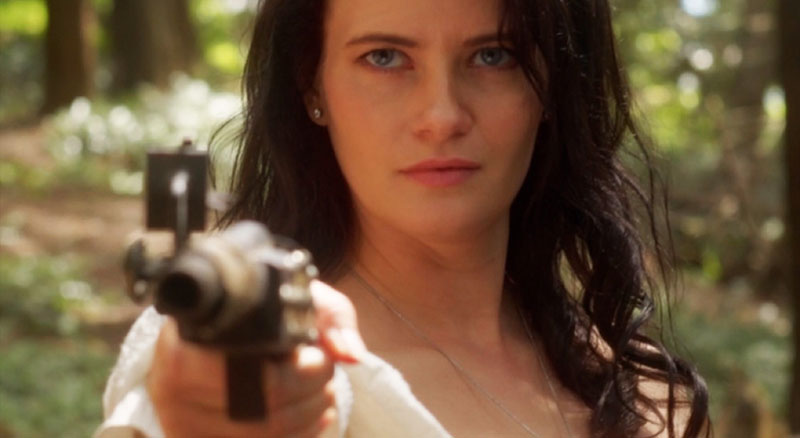
Steven commented on the appreciation he has developed for the portrait-designed frame as an art form unto itself. For Julie, working as an actor in the format also influenced their approach. “Stillness is key, since you have less space to move in the frame, and any blocking must be done very intentionally, as movement translates differently,” she said. “The goal was to keep characters feeling grounded and real, with dashes of classic pirate wit and fun.”
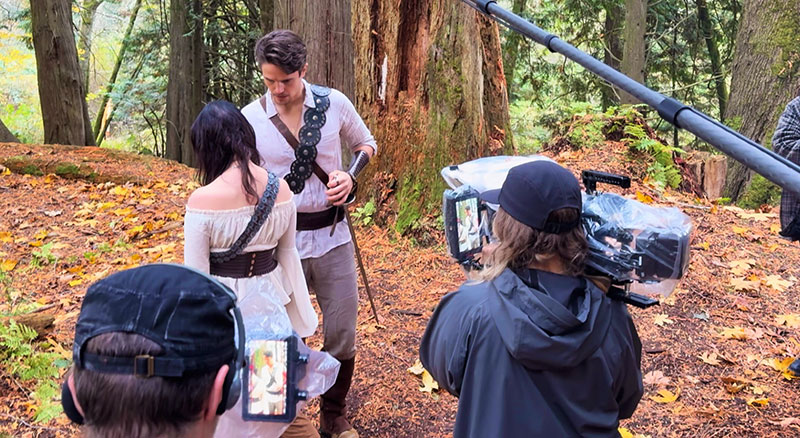
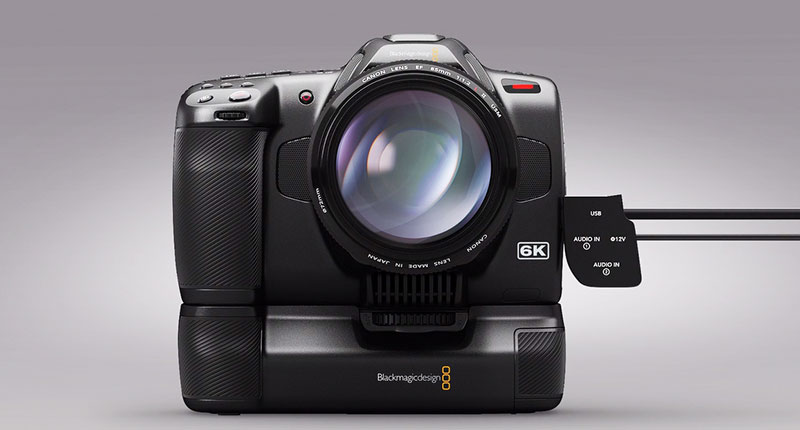
The production’s main camera was the Blackmagic Design Pocket Cinema Camera 6K Pro. For a production shooting across remote wilderness locations, some requiring a 45 minute hike to reach, the size and speed of the camera were important factors. “Being able to pack the camera kit into those remote locations made all the difference,” said Julie.
Composing for 9:16
For Grace Loeppky, the DoP, the camera was already a familiar tool. “The Pocket Cinema Camera 6K Pro paired with my DZO Pictor zoom lenses has been my workhorse camera package for years,” she said. “The internal ND filters definitely speed up the process and were a big reason for buying this camera in the first place. The colour science is great, and I often discuss with colourists how nicely it renders skin tones.”
Grace and cinematographer Rob Hunt noted that the internal NDs helped them keep the shoot moving quickly on set, and the Blackmagic RAW codec gave them ample flexibility in post.
On Steadicam setups, Rob used the PYXIS 6K due to its compact form factor, which helped with balance during movement. “The size and flexibility of the PYXIS 6K opens up so many options for the future,” he said. “I want to push its use on future vertical productions, particularly where having flexibility in the rigging is a priority.”
Shooting her first vertical project taught Grace that composing for the 9:16 frame requires an entirely different instinct. “Framing headroom is very different from landscape and requires much more space,” she said. “I had to forget about 50/50s – shots with two subjects – and work hard to make a two shot look and feel nice. That said, I could take advantage of movie magic by framing out so much of the world, which benefited this production because, for the most part, we didn’t have the means to dress huge spaces.”
DaVinci Post Pipeline
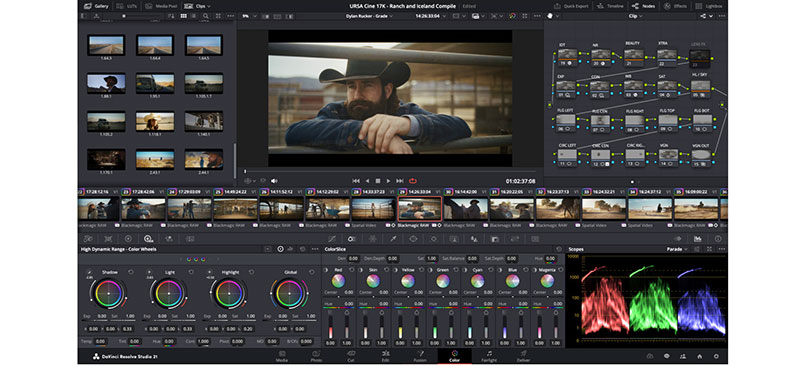
The entire post pipeline ran through DaVinci Resolve Studio. Editor Brian Clement and Co-editor David Titus cut the film and Colourist Phoebe Titus completed the grade. Brian noted that the Blackmagic RAW capture gave the edit real room to move.
“Shooting in such high resolution formats resulted in a lot of flexibility in terms of reframing shots, creating new camera movements in post, zooms, pans and adding dramatic emphasis with abrupt smash cuts and closeups,” Brian said. “Especially for something that often plays on a phone screen, it meant that, if needed, we could radically change in editing what had been originally shot.”
Phoebe has worked in DaVinci Resolve Studio for over a decade and is also a longtime collaborator of Julie and Steven. She loved starting with the Blackmagic RAW files. “It allows so much latitude to work with,” she said. “Blackmagic cameras always pick up magenta and blue in a nice way, which let me work with some great cool undertones in the shadows.”
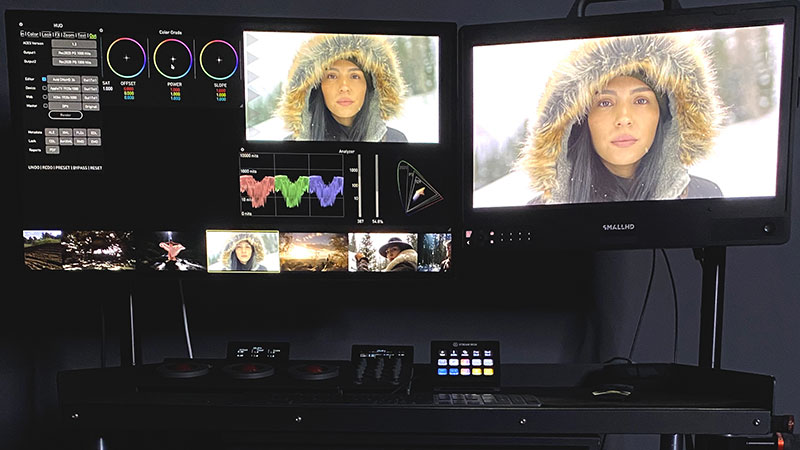
Because working vertically was a new experience for Phoebe, the shift took some adjustment. However, DaVinci Resolve Studio has a UI developed specifically for vertical productions. “The fact that the viewer, node tree and OFX positions are swapped took a bit to adapt to,” she said. “But once I got used to it, I liked it a lot. It made me realise that I don’t need to look at the node tree so much. I needed to focus on the window, the scopes and the screen, and that’s it.”
Phoebe had moved into colour grading from a background in fine art rather than cinematography, and therefore found the vertical frame a fairly natural fit. “I’ve never understood the obsession with widescreen in film,” she said. “Other aspect ratios can be just as gorgeous and effective, and now with digital we don’t have the limitations of film stock.”
Pushing the Grade
Grading for a phone screen also meant pushing the grade harder than usual. “Since many viewers weren’t going to have the benefit of a larger screen, I needed to pop contrast and brightness more than usual. Both contrast and brightness need to follow along in more of an S curve in vertical layouts, and often the focus is on the upper third of the frame rather than the right hand third,” Phoebe noted. Curves can be used to correct over and under exposure, but also to correct washed out images by creating an S curve – adding nodes to the curve and dragging in opposite directions.
She singled out Grace’s compositions on the boat and in the water as particular highlights. “Grace has such a great eye. Those compositions aren’t possible in horizontal aspect ratios and gave the project some nice bold looks.”
One of Phoebe’s favourite moments in the grade was a transition between a yellow green autumnal forest and a misty blue green one. “Vancouver is great for getting that kind of variety on the day, but it was lots of fun to really make the most of that contrast in the suite, bringing out the misty cool greens in one and the amber sunlit greens in the other.”
Having the edit already in Resolve made the hand-off to colour straightforward. “Online was easy,” said Phoebe. “One foundational characteristic I love about Resolve is that it’s relatively stable. It’s easy to forget that, because it’s the absence of something frustrating. But I remember it every time I’m in a different program that crashes on me.” www.blackmagicdesign.com
'Beneath Crimson Sails' is now available on MuVpix.