

Blackmagic Design introduces the Photo page for stills, AI search and VFX tools, keyframing and graphic format support, optimised colour workflows and simpler audio track navigation.
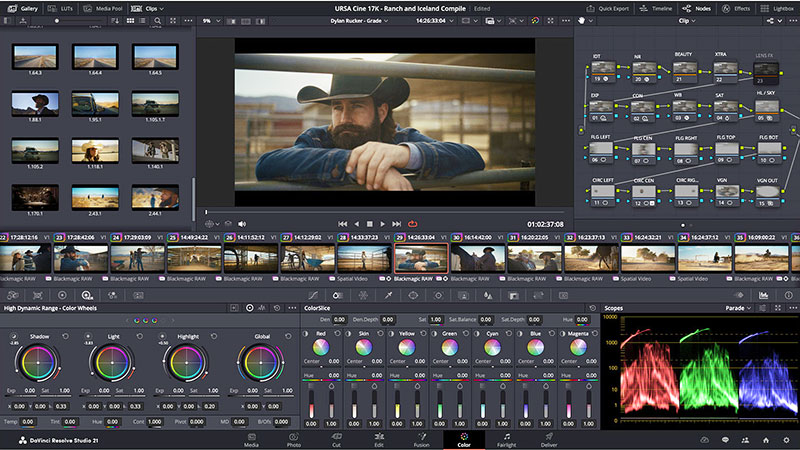
Blackmagic Design DaVinci Resolve 21 brings many new introductions to the software, starting with the new Photo page, where colourists and photographers can use Resolve’s colour tools for still photos.
The AI tools collection has grown with new features like IntelliSearch for fast content searching, CineFocus for focal point adjustment and tools for facial refinement. The Krokodove toolset adds a large collection of new graphics to Fusion, Fairlight folders simplify audio track management. Further improvements have been made to keyframing, MultiMaster trim passes and layer list node graphs.
PHOTO PAGE
DaVinci Resolve’s post-production workflow now integrates still photo image editing through a new Photo page. Users can import and manage photographs, while integrating with the Colour page for node based grading. Another feature is the ability to reframe and crop images at their original source resolution and aspect ratio. Every adjustment preserves the original file’s full quality, so that the composition can be refined at any time without affecting image quality.
The software’s primary colour correction, curves, qualifiers, power windows and node editor are available to make creative, artistic colour adjustments across an entire project. A DaVinci colour panel is included to adjust multiple parameters at once, and then distribute across the project in the same way.
Albums
Nodes can be added in series or in parallel to build complex grades, apply different corrections to different parts of an image simultaneously and use shared nodes to apply the same look throughout an entire album of photos at once.
By using the Albums feature in the Photo Page, the user builds and manages collections directly in Resolve, based on shoot days, camera models or other criteria. It’s possible to tag and make raw setting adjustments in batches, saving time. For access, Albums appear as timelines on the Color, Cut and Edit pages.
LightBox view, also on the Photo page, gives an overview of the entire album with grades applied. Selecting an image and grading it displays the results live as they update across the whole collection in real time, which can be filtered by graded, ungraded, star rating, flag and clip colour attributes for fast library management.
FX Plug-in Support
Resolve FX and Open FX plug-in support is available for still images on the Photo page, for applying effects, graphics, transforms and DCTLs (custom colour transform tools using DaVinci Color Transform Language). Looks can also be applied directly in the Photo page with the help of LUTs, or by generating LUTs to apply looks in-camera or while monitoring.
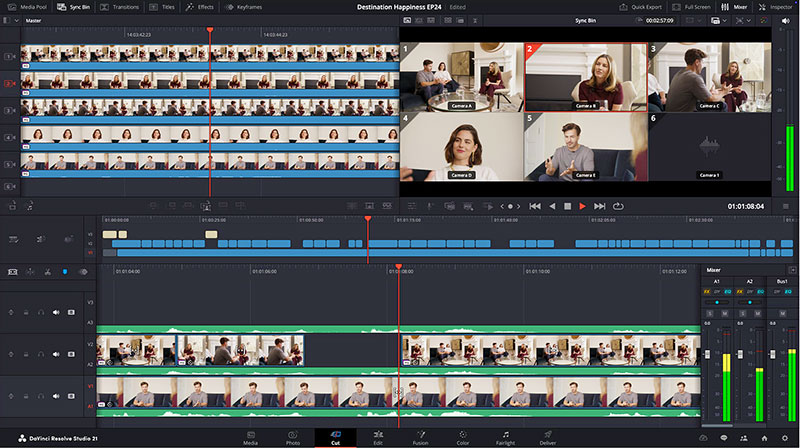
DaVinci Resolve’s native AI tools (see new ones listed below) can be accessed through the Photo page, and the whole Photo page is integrated into DaVinci Resolve’s multiuser collaboration workflow using Blackmagic Cloud. Teams can share the contents of albums, all associated metadata and tags, and all grades and effects between colourists, visual effects artists and editors, simultaneously anywhere in the world.
AI TOOLS
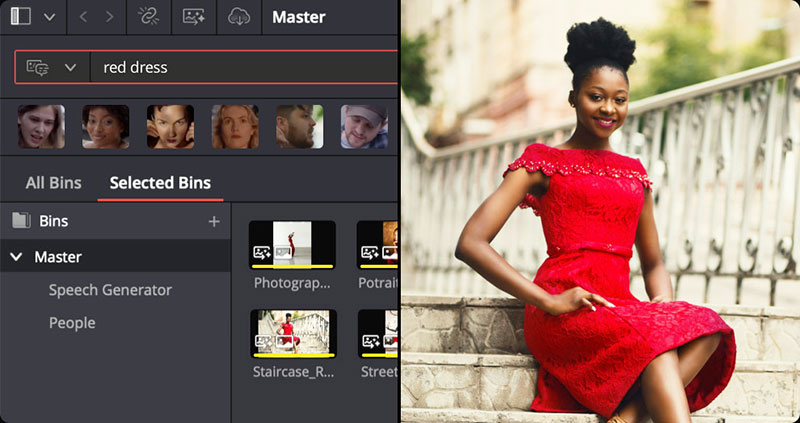
A number of new tools have been developed for DaVinci’s native AI Tool collection. AI IntelliSearch instantly searches for people and content, first analysing media and using the IntelliSearch tool to find specific objects or key words in dialogue. Users can also use it to search for individual faces. Results appear as whole clips in the Media Pool for fast clip organization and editing.
Users can generate speech from written text using one of Blackmagic’s voice models or a sample of their own using AI Speech Generator. Starting from a 10 second clip, the DaVinci AI Neural Engine is able to create a unique voice, which users can then adjust for speed, pitch and inflection to create multiple performances for voiceovers, narration and so on.
AI CineFocus defines the focal point of a shot. The user first clicks to focus on a particular area of a scene and then adjusts aperture and focal range to change the depth of field. Aperture shape and optical effects like bokeh are also selectable, and certain parameters are also keyframeable to rack focus.
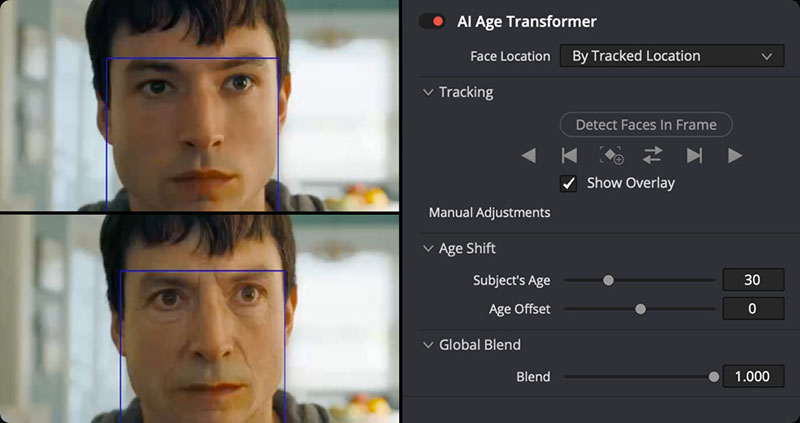
The AI Face Age Transformer tool helps to maintain continuity in flashbacks and flash-forward scenes by changing an actor’s age. It analyses the face and, starting from the subject’s current age, the age offset slider adds or removes age-related features such as wrinkles and facial fullness.
The AI Face Reshaper changes the shape and position of facial features on a moving subject. After detecting and tracking a face in a clip, the Reshaper’s parameters are used to adjust the eyes, nose, mouth, eyebrows and overall face shape. Manual controls are still available to fine-tune the resulting face.
The AI Blemish Removal tool minimises the impact of superficial skin imperfections such as acne, discoloration, spots and pores, but retains the texture of the natural skin. The strength slider adjusts the intensity of the tool’s effect to suit the subject in the scene.
AI Slate ID automatically detects the slate clapperboard details. It intelligently extracts metadata from the slate in the frame, even in dark or out-of-focus clips and saves a lot of time in metadata entry. Media is prepared for editing much faster than was previously possible.
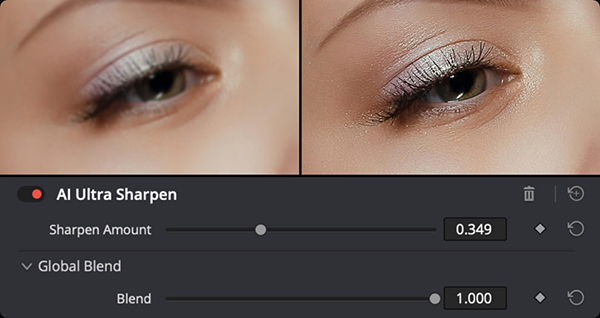
DaVinci’s new AI UltraSharpen tool produces significantly clearer moving images from high quality video. Especially valuable for upscaled videos, it can make previously unusable footage sharp enough to use at higher resolutions. AI UltraSharpen can also be used to improve or fix slight focus errors.
Users can remove common motion blur artifacts, such as streaks and softness, from video content using AI Motion Deblur. The tool analyses the source media file and generates a new render with less blurring, resulting in slow motion and freeze frame effects with greater impact.
Fusion
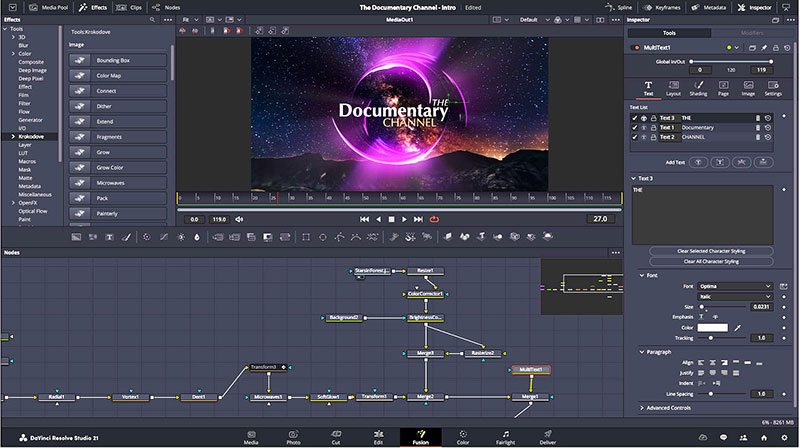
Fusion now features Krokodove, an on-going library of compositing tools. The collection ranges from utility tools that improve productivity, to essential vector and data tools, to customisable 2D and 3D graphic templates that can be used throughout DaVinci Resolve. In DaVinci Resolve 21, Krokodove adds over 70 new graphics to Fusion.
Building your own Fusion tools and templates is now easier following the updates to the macro editor, with interface improvements that make customising tools and templates faster and more natural. Using the new inspector view, developers can quickly set up, format and publish macros for immediate use.
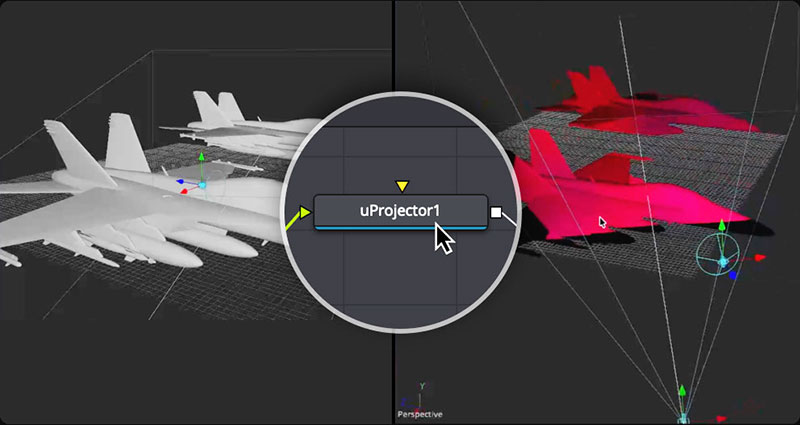
The USD toolset has been updated to USD SDK 25.11 with Hydra 2.0 API for the Storm renderer. This change improves the Fusion USD environment for VFX artists with support for 3D matte objects and textures, USD Texture Projector and Catcher, plus global in and out controls for the USD loader.
The Fairlight Animator modifier connects Fusion to Fairlight’s audio engine, which will automate animation based on audio analysis. The audio levels from timeline clips or media pool sources are used to drive the control of parameters such as eyes and lips, producing dynamic animation automatically.
To optimize Fairlight timeline space, editors can now assign audio tracks to a folder and collapse into a single composite view. When collapsed, mini rectangles represent the folder contents, indicating the number and duration of the contained clips. Expanding a folder accesses the individual tracks.
Apple Immersive
The image processing of the 180-degree, 3D 8K Apple Immersive Video recording format now includes support for foveated rendering, which simulates human vision through its ability to focus its high-resolution rendering only where viewers are looking. Because it reduces GPU workload in the peripheral vision area, playback is improved and the viewer experience overall is enhanced.
DaVinci Resolve 21 aims for wider support for immersive tools and workflows. The standard immersive option in the master project settings allows users to work with supported immersive formats for delivery to platforms such as Meta Quest and YouTube VR.
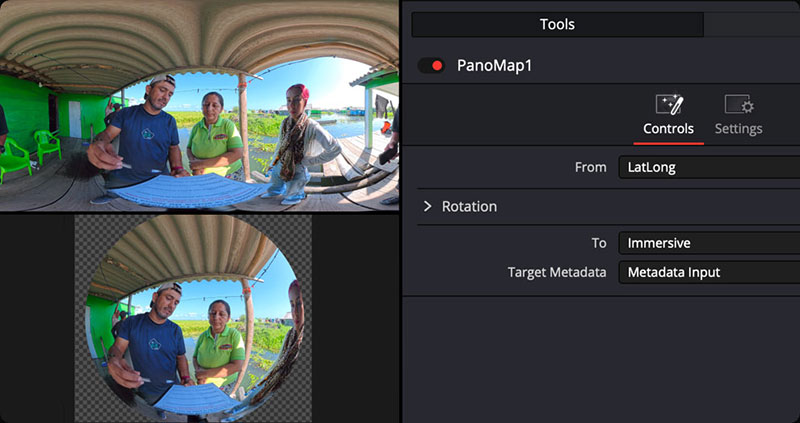
It is now possible to orient immersive media using spherical Panomap rotation for pitch, tilt, pan, yaw and roll adjustments that feel more natural. Users can also apply ILPD [ImmersiveCameraLensDefinition] retargeting data in the Fusion page, giving them more options and accuracy when handling and compositing stereoscopic media. The ILPD lens configuration parameters generate the camera calibration.
CUT AND EDIT
In the revamped Keyframe and Curves Editor in the Cut and Edit pages, keyframing includes new ease animations to use between keyframes with loop, pingpong and relative modes plus simultaneous adjustments to multiple clips. The curves editor has a normalised zoom mode that automatically scales curves to fill the available vertical space, and four-point Bezier easing to support complex video retiming.
Fusion effects can now be adjusted directly in the editor. Users can tweak text, transitions and motion graphics without leaving the editing pages, resulting in smoother workflows. Changing over to the Fusion page is only needed for complex VFX adjustments.
This update focuses on unifying the user experience, increasing the effectiveness of the Edit page, and giving greater control over clip timing and animation.
OGraf HTML Graphics and Live image Capture
Native support for OGraf HTML graphics and LottieFiles animations means that you can now drag .json and .lottie files directly into the media pool for handling in the same way as fully rendered animation clips. Alpha channels are recognised as well so that graphics and titles can be layered over video tracks.
The EBU’s OGraf HTML is a modular approach to video graphics that can be integrated into existing systems. It serves as a framework with an open specification that allows the user to create graphics once and then render them directly onto traditional broadcasts, digital platforms, video editing tools and web streams, in live and non-live applications.
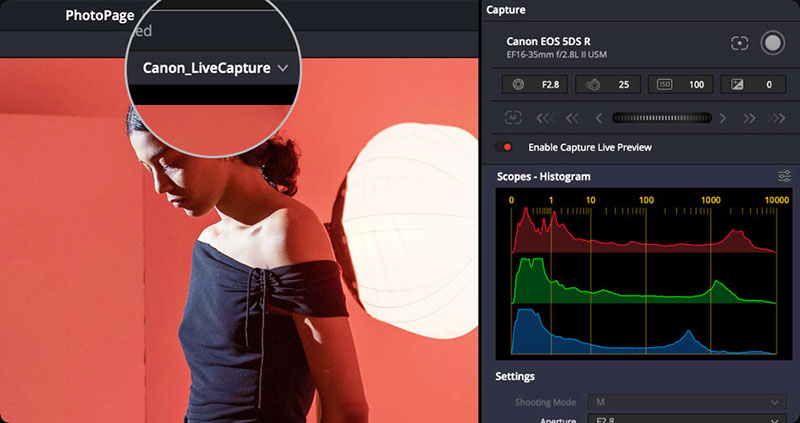
Camera operators shooting with Sony or Canon cameras now have the option to tether directly to DaVinci Resolve for live image capture using Camera Controls. Settings such as ISO, exposure and white balance can be adjusted while monitoring with live view and saved as capture presets. This defines a consistent look in-camera before shooting. Meanwhile, the images will save directly into an album.
Users working with text can now set up multi-language spell checking for all text elements, preview fonts in a dedicated font browser window and use emojis in text. For titles, character-level styling features will assign different attributes such as font size, weight and colour within a single text box.
Smart Bins, HDR / SDR Trim Deliverables
In the Cut page, the bin list dropdown now features smart bins and quick access buttons for creating new bins. Smart bins are used to design and customise media pool filters based on a wide range of very specific rules and criteria. Filters can be set, for example, to display only .braw clips that have been flagged green.
Using the MultiMaster trim manager, an operator can generate multiple HDR and SDR trim deliverables from a single timeline. When enabled, the node editor will display further layers for trim operations, and the operator then colour manages the timeline for each output standard and renders each iteration in one go.
The Magic Mask palette now has a render-in-place option that caches a tracked mask as a travelling matte node. The resulting matte will automatically link to the active node, while grading and effects tasks continue in real time with significantly lighter processing.
Nodes are listed in rows according to their number in the node graph. The intention here is a less crowded interface, making nodes easier to manage as they are added, labelled, switched, locked, bypassed and removed.
The new Picture in Picture Resolve FX resizes and repositions a video clip over the top of another clip, as a floating frame to serve in presentations, reviews and reaction videos. Users can adjust size, placement, frame rounding, drop shadow and other, similar parameters.
Fast Timeline Assembly
IntelliScript now supports Final Draft and plain text screenplay formats to help assemble timelines quickly. When the script is imported, IntelliScript compares the script text to the original transcribed audio and creates a cut of the scene. Editors can then fine tune the result using standard editing tools.
New media management columns in the media pool database are added to access the new rating and tagging parameters in the Shot and Scene category of the metadata panel. To filter out and identify optimal takes and performances, teams can rate clips on a five star rating system, or use the standard Good Take, Untagged or Rejected tags.
DaVinci Resolve 21 public beta is available for download now from the Blackmagic Design web site. DaVinci Resolve 21 is being demonstrated at NAB 2026 at Blackmagic Design's stand. www.blackmagicdesign.com