
BlueBolt was lead vendor on 'Tom Clancy's Jack Ryan: Ghost War' following the Amazon action series, extending a skyscraper, enhancing a boat chase and smashing a glass floor 20 floors up
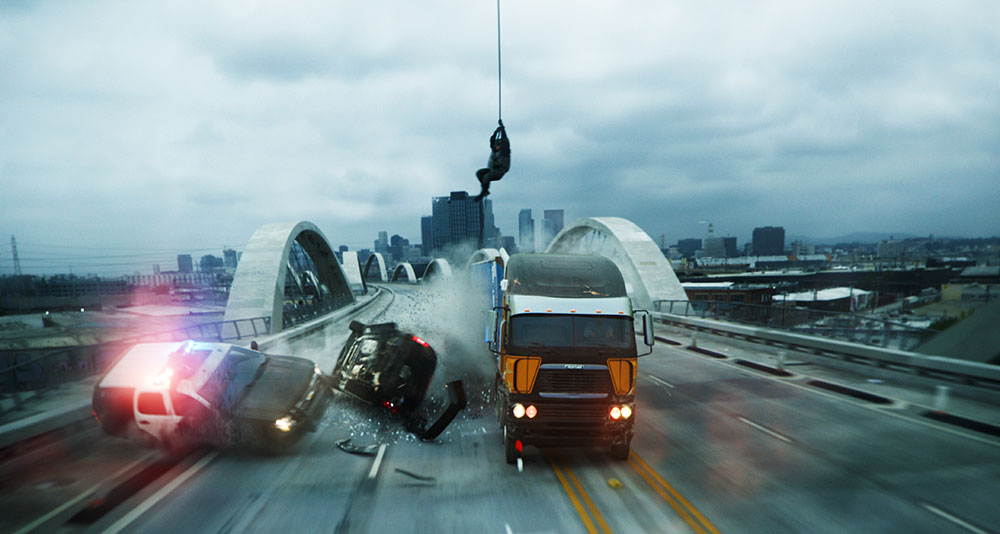
BlueBolt served as main VFX vendor on Tom Clancy's Jack Ryan: Ghost War, a feature film that continues the story of the action series from Amazon. The BlueBolt team, led by VFX Supervisor Richard Frazer, delivered 365 VFX shots to enhance the drama and danger with explosions and gunfights, and created numerous CG urban environments ranging from London to Dubai and New York.
As overall creative lead for the film’s visual effects, Richard worked closely with director Andrew Bernstein from pre-production onward to develop and design the visual effects for the film's key sequences. “I was involved with the production from pre-production in late 2024 through to final delivery in February 2026,” he said. “I was on set every day during the two-month London shoot. The first four weeks of the shoot took place in Dubai, where Artemis Oikonomopolou covered as the on-set VFX Supervisor for BlueBolt.”
Blow Up
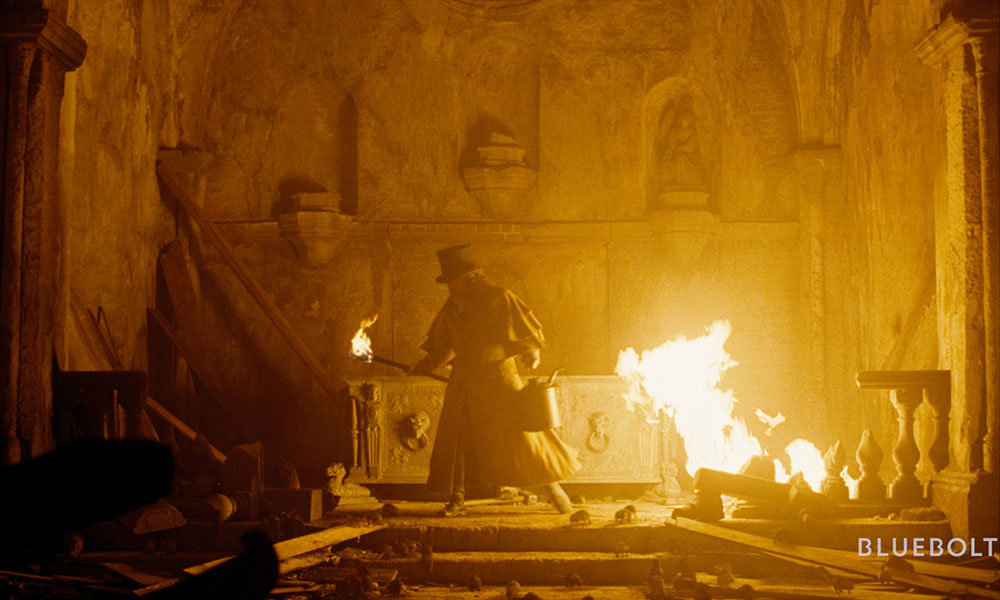
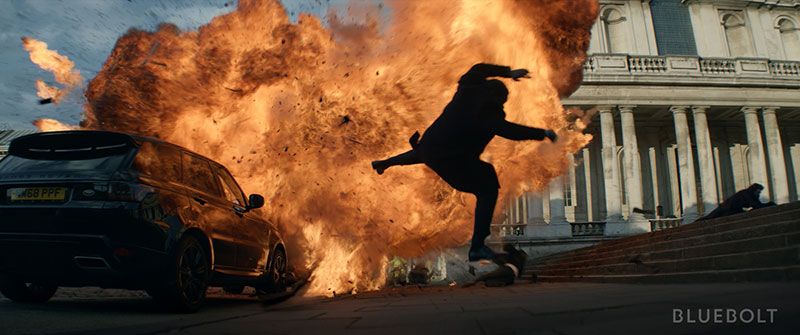
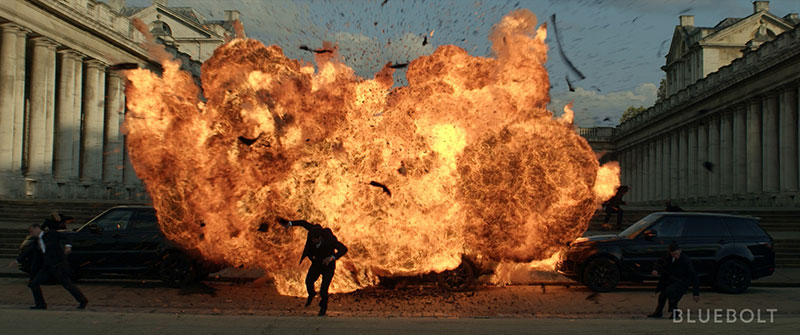
A car bomb explosion you can see near the beginning of the breakdown video here is an impressive example of the level of detail and integration BlueBolt needed to achieve for this project. According to Richard, it was one of many moments where credit is due to the SFX team for their practical work. “The main issue we faced was getting permission to blow up a car at Greenwich Naval College – the owners were understandably concerned about damage to the historical buildings and we were negotiating a solution until just a few weeks before the shooting date,” he said.
“The initial plan had been to shoot a separate insert element of the exploding car at a different site. But we soon realised that the amount of bluescreen required to cover all intended camera angles would have meant stacking shipping containers into a 200ft square box and it quickly became impractical.
“In the end the SFX team created a 'soft' explosion by firing cork dust into the air and igniting it. This created an amazing fireball, but without the damaging force of a 'hard' explosion. BlueBolt then extended the practical effect, adding flying CG debris, shattering windows and twisting bodywork. They also added lots of CG smoke, fire and additional damage to the aftermath.”
Glass Floor
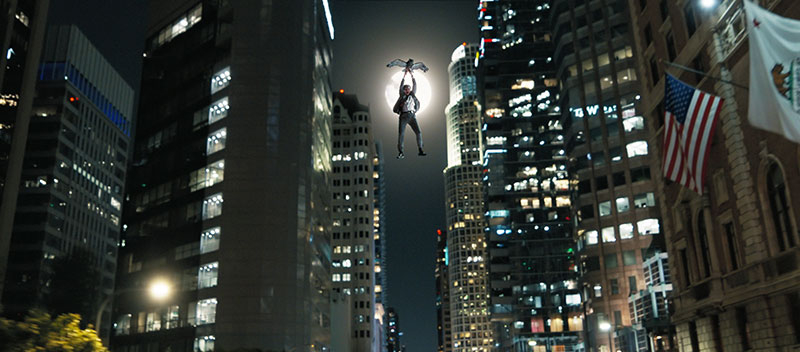
The team’s most demanding sequence, seen shortly before the explosive finale shoot out at the top of a skyscraper, features the cracking and collapse of the entire glass floor inside the building’s tower. BlueBolt played a central role in planning the complex 'Glass Floor' sequence on a shot-by-shot basis and helped oversee the virtual production elements of some LED volume work done for this movie.
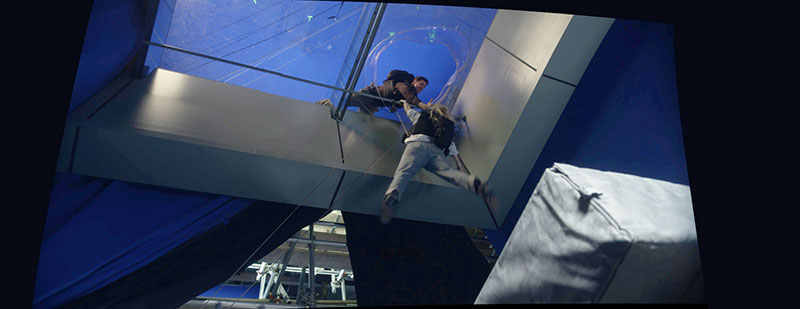
The Glass Floor sequence centres on a dramatic moment in which an entire glass floor cracks and collapses, leaving one of the characters suspended through the resulting hole. The sequence was filmed at a nightclub within Dubai's One Za'abeel, a real glass-floored structure 20 storeys above ground. Following principal photography in Dubai, Richard helped plan an additional UK studio shoot involving extensive stunt rigging and bluescreen work on large glass floor panels.
Massive Collaboration
He outlined the process. “In the story, the gunfire ends up rupturing the floor, which collapses, leaving our heroes dangling in the air. The sequence had been storyboarded before we flew out to Dubai, so we had worked out what could be shot practically and what would become part of the VFX pickup shoot later.
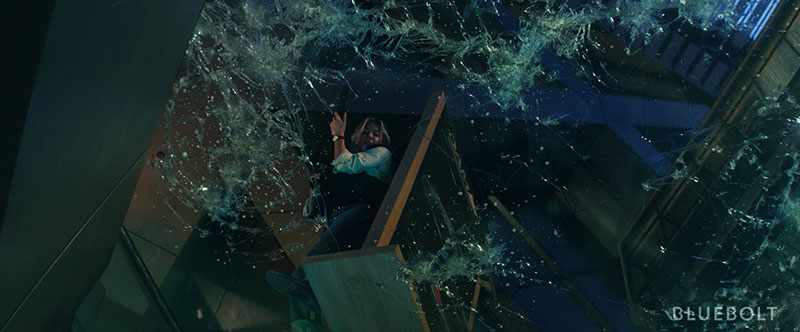
“An assembly cut was then edited with the Dubai footage and I created some very rough animations using the storyboards to help fill in the missing shots. Though it would have been a stretch to describe them as pre-viz, from these animations, the director Andrew Bernstein and I could put together a shot list to work with on a bluescreen stage that we built in London at Shinfield Studios.
“We created a breakdown for each shot that showed positions of cameras, bluescreens and so on, that was shared with the camera, lighting and stunt team to make sure we all knew what we were trying to achieve. It was a mammoth collaboration between departments, involving working on a suspended glass surface 18 feet in the air.”
Reflections and More Reflections
Every surface was made of glass, with some occasional structural steel supports creating complex layers of reflections throughout the environment. It was nearly impossible to survey the location – LiDAR wouldn't return reliable data from the glass surfaces, while photogrammetry struggled because there were few solid features to track. Reference photography was of limited use. At night, which is the setting of the scene, viewers see either the lights of the city outside or reflections of reflections – of even more reflections – of the interior.
“We initially laid out every camera in the sequence to determine which parts of the room would be visible, but it quickly became apparent that we needed to model a complete CG environment, as even areas behind the camera were going to be seen in reflections,” said Richard
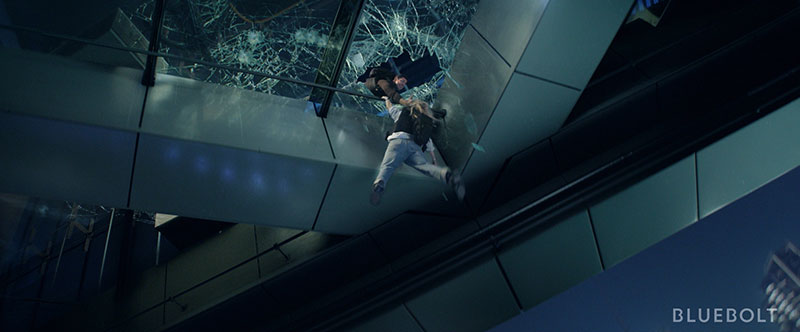
.
“Thankfully the art department had taken extensive measurements and had also tracked down an architectural model used in the construction of the building, so our VFX team used this information to build the 3D model. The most valuable asset we gathered was a panoramic view of the city, shot on the drone hovering outside the 22nd floor. BlueBolt stitched this together in Nuke to create a 32K spherical view of the city outside.”
Lighting
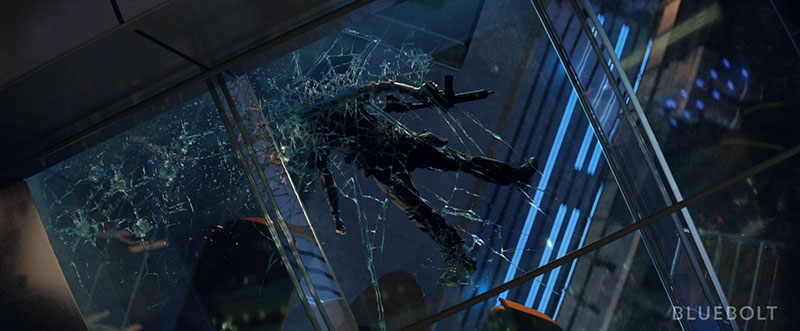
To help light the 3D scene, the lighting setup in the Dubai shoot was captured with HDRi on set. Distinctive, practical neon blue lights installed in the ceiling of the nightclub could be seen in reflections everywhere, and the lighting department added diffuse warm balloon lights to soften the look.
They lit the London bluescreen pickups to match the Dubai photography as closely as possible but, with stunt rigging and bluescreen to work around, they encountered some practical limitations. “So, we graded our plates to match the CG, rather than the other way around,” noted Richard. “The most important thing to be aware of was that, because the edit cuts back and forth between the real location and full CG environment shots, they had to feel consistent.”
The Staging of Destruction
The sequence demanded that certain very specific story beats be emphasised while maintaining the fast pace of the action. This meant realistic dynamics and material behaviour had to be combined with precise control of staging and timing. After studying as much reference of breaking structural glass as they could find, they developed and guided fracturing methods that allowed BlueBolt's artists, led by CG Supervisor Dave Cook, to control the breaking direction and timing of the glass while maintaining realism and detail.
Several methods were used for simulations in Houdini on the larger shots. This work was beautifully detailed. For the exploding bullet hits on the glass floor, larger fragments were simulated with rigid body dynamics and a fine particulate dust, sometimes a volume, and the revealed impact craters were modelled into the residual floor surface.
“The main disintegration of the floor surface had a network of spidering cracks driven by guided curves, allowing the main shapes to be directable,” Richard said. “On top of the primary cracks, secondary and tertiary cracking simulations were run off of the primary one to add depth by suggesting the cracking of different layers of laminated glass. The depth of the cracks implied the loss of structural integrity of the floor. Inside each crack the 'ribbon' of the crack was affected by noise deformations to adjust the roughness or smoothness of its reflection.”
Falling Through the Cracks
With this fragile groundwork in place, they addressed the characters who fall through and are left suspended. BlueBolt could apply roto animation to create proxy geometry of the characters and use it in the 3D scene as a collider object for the falling glass and to cast shadows and reflections on the glass surfaces.
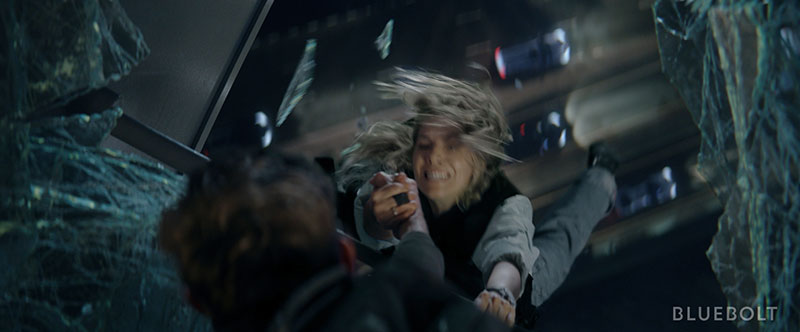
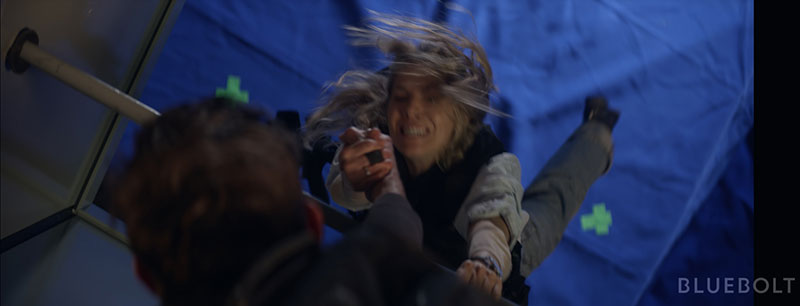
He said, “The hole itself has a full shattering sim for the break. The shape of the resulting collapse was then adjusted to accommodate the following bluescreen drama shots and a version of it was made with tearable constraints, which allowed varying size chunks and individual pieces to detach and fall.”
For the lighting here, all done with Arnold, the team used animated normal maps to suggest chunks of glass shifting and ST maps to incorporate refractions from elements that were not part of the 3D build, such as the skyline. This meant using a high number of refractive ray bounces – up to 40 in some shots.
The Damac Tower
For the film's explosive finale, the top of the Damac Tower in Dubai became a key location – a real skyscraper actively under construction during the filming of the movie. Covering all of the complex story points required about 230 VFX shots, adding in the Dubai city skyline outside and helping to augment the heavy SFX requirements including muzzle flashes, massive CG glass smashes and explosions.
Because permission to film atop Damac Tower was difficult to acquire, BlueBolt augmented its design with an extra 24 floors of CG top-up tower as an extension, allowing the heroes to climb to its top.
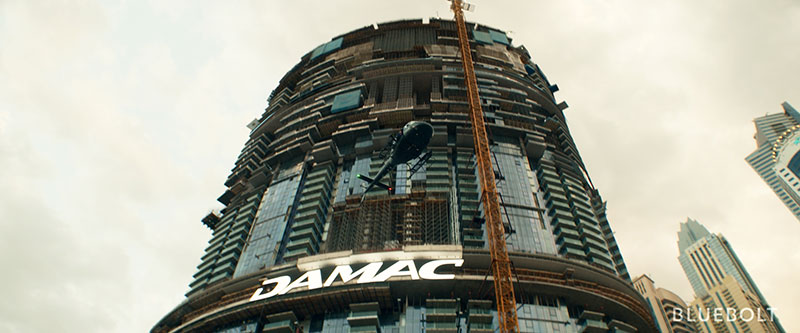
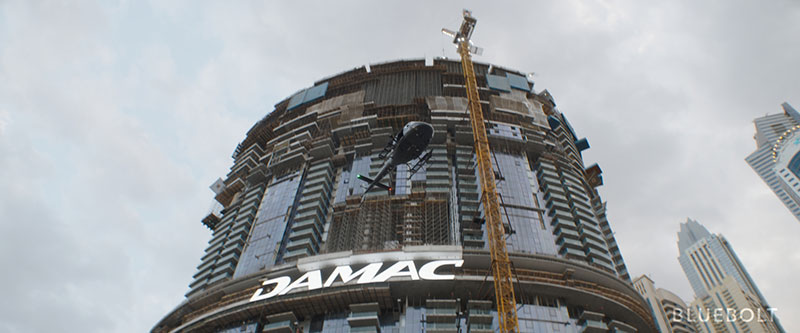
The film's action comes to a climax inside the Tower’s fictional Server Floor – in effect, within the extension. As this room didn't exist in the live action set, it was constructed on a blue screen stage for the shoot. While the stage took care of the room’s interior, whenever the exterior of the fictional Server Floor needed to be seen as well, BlueBolt’s CG extension was added to shots showing the exterior of the building.
Controlled Set – Continuity and Realism
“The interior set was built in our Mortlake studios in London, where the shoot took place,” said Richard. “The VFX team added the Dubai skyline into around 200 shots to replace the bluescreen behind the set windows, creating the views. Having the controlled set also meant the SFX team were able to rig all kinds of pyrotechnics to help with the destruction.
“The exterior shots that we captured in Dubai then had to match the same level of destruction, so this meant VFX to add in CG explosions, breaking glass, fire and destruction, using the pyrotechnics as a visual guide. This was all simulated in Houdini and composited in Nuke.”
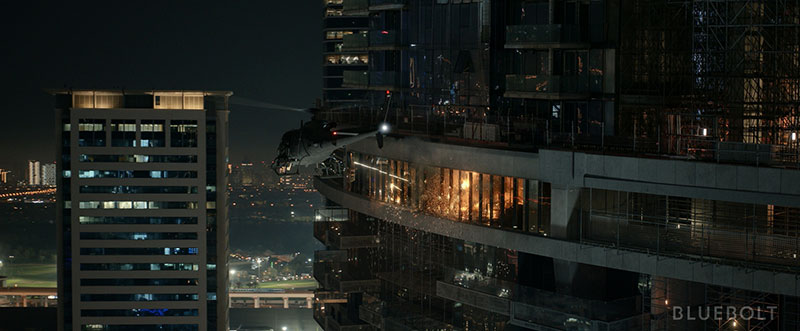
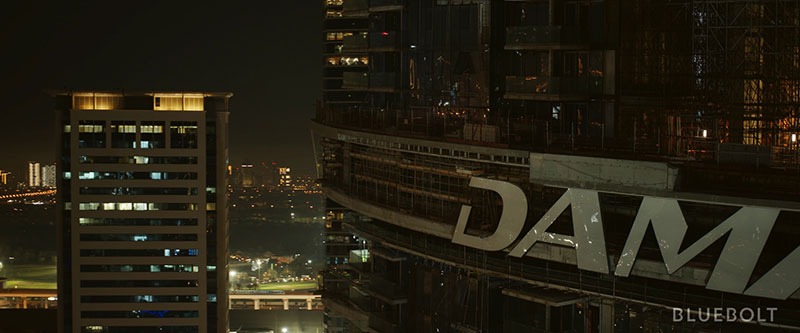
The action beats include swinging a massive pallet in through the windows, requiring a CG helicopter gunship dramatically shooting up the floor with a minigun – with interior and exterior views. Owing to the complexity and the need for continuity, again, the majority of exterior views were fully CG.
The pallet smash was achieved with a real pallet of bricks that was launched through the glass windows on a hydraulic rig. The minigun strafing through the windows involved a huge amount of practical explosives and shattering glass panes. This gave a highly realistic in-camera effect and meant only minimal VFX enhancement work was needed for the interior shots.
Helicopter Gunship
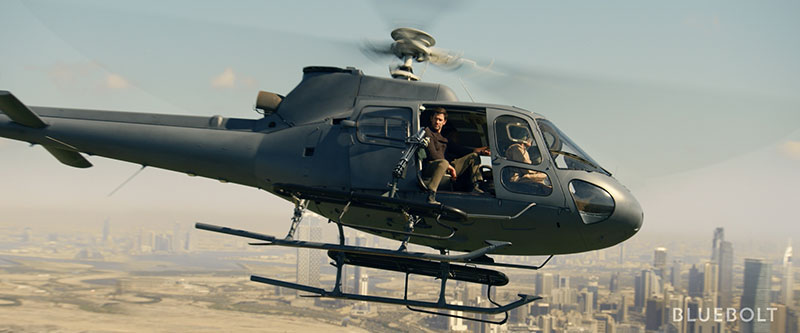
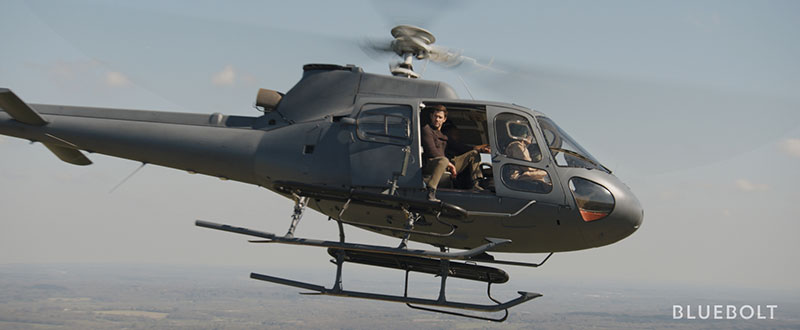
However, the helicopter gunship the team built in CG was a complex asset. Richard commented, “Initially, we flew a real helicopter outside of the Damac tower and shot aerial plates using a drone. The intention was to use the real footage and just add in the muzzle flashes of the minigun. We were only going to build a basic 3D model of the helicopter to work as geometry for light interaction renders.
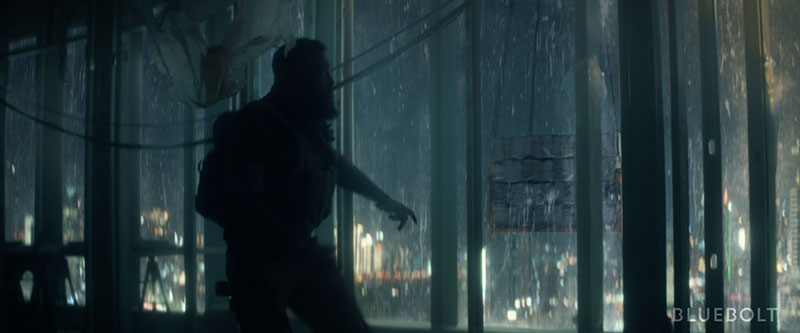
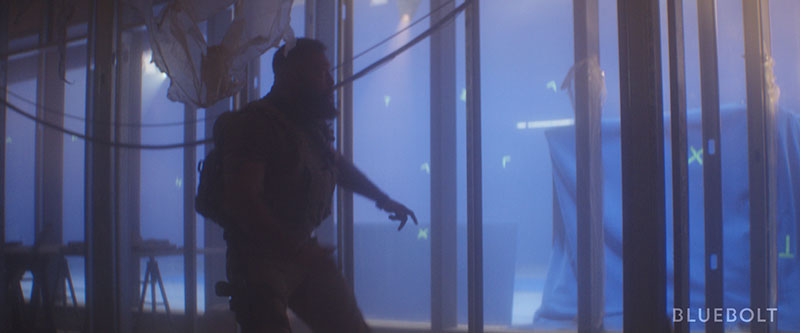
“But coordinating the position of the helicopter and the drone relative to each other in space proved challenging, while maintaining a safe flying distance from the building at the same time. We got some amazing footage, but the framing was just not quite right. The basic helicopter model had become surprisingly detailed as well, so it made sense to fully texture it and replace the real helicopter entirely.”
For the aftermath scene when our heroes board the helicopter and fly away, the team at BlueBolt had to employ a mix of the real helicopter that was shot in Dubai containing digi-doubles of the actors, the full CG helicopter and the live actors in a real helicopter that was shot in the UK and had background plates of Dubai added in. He said, “When it's all edited together, a viewer would never know which part was which.”
Dubai Marina
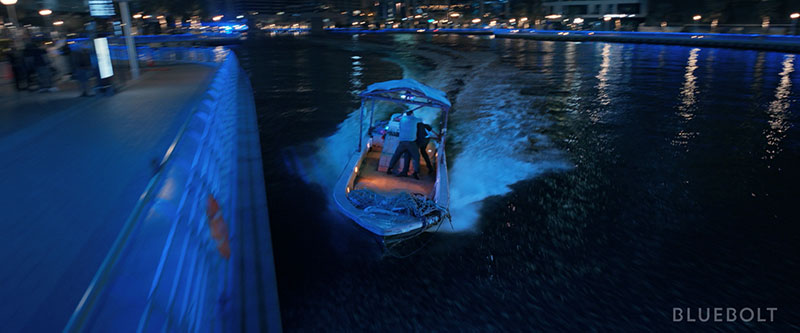
The boat chase through the Marina in Dubai was enhanced by numerous additional CG boats to heighten the danger. Several camera and safety boats following the action during filming needed to be removed and CG water added back in their place. “Like much of the film, this sequence relied heavily on practical stunt work,” Richard noted. “Those are real boats you see, speeding through the marina in Dubai and crashing into a wall. The main contribution from VFX was aiding the crash and adding additional traffic into the waters.”
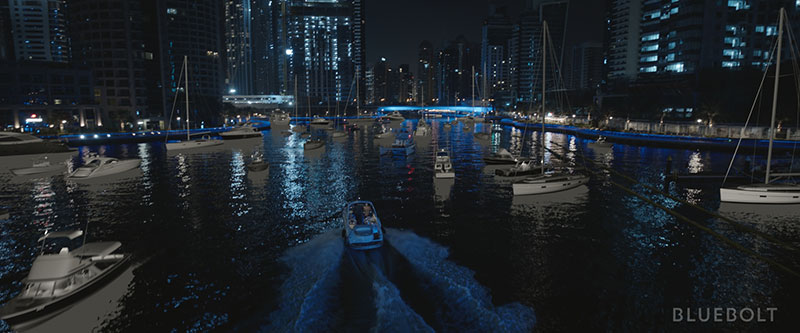
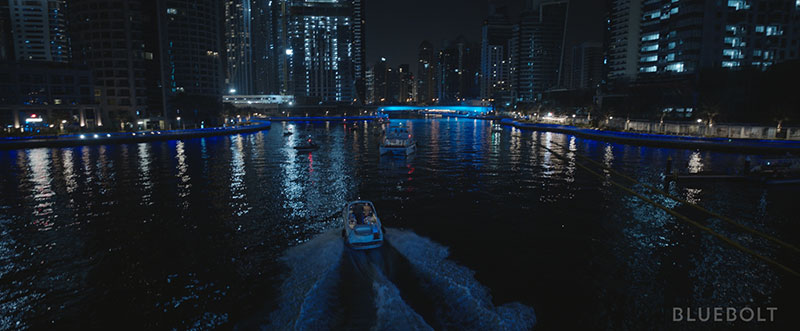
The chase culminates in a dramatic crash into the wall of a bridge. Practical protection required on the shoot day to prevent damage to the structure, was digitally removed later. The team was required to protect the marina from damage during the crash, so a protective barrier was built and then replaced in post with a CG concrete wall. Further CG boats were added to make the marina appear busier.
For the big stunt moments, the camera boats, safety boats, drones and camera bikes all appeared in shot, so these needed to be painted out. The VFX in this sequence was handled by BlueBolt.
Face replacement was also used on shots involving stunt performers. We used ComfyUI's ReActor as a starting point for the face replacements, but every shot still required traditional compositing work in Nuke to reach final quality. www.blue-bolt.com
Words: Adriene Hurst, Editor